Bad Tree Choices

Bad Tree Choices…You mean every tree isn’t “good?”
Intrinsically, all trees are good as they produce Oxygen (O2) for all living creatures, sucking in the harmful Carbon Dioxide (CO2) and performing the process of photosynthesis, necessary for all plants to survive, but that doesn’t mean that ALL trees are good as far as landscapes are concerned, or maybe a “good choice.”

What is photosynthesis?
Photosynthesis is the process that occurs in nature, vital for us, other animals and other creatures and also for plants. The process uses water, light and CO2 to produce O2, Glucose (sugar- C6 H12 O6) and chlorophyll. Clearly one can see that we all work together so that we call can live, whether human, dog, insect or plants.

We’ve read in a previous blog about good trees for landscapes, but what are some poor choices?
Let’s start with a family of trees that although certain varieties produce edible fruit, all can easily turn out to be unhealthy and unhappy; anything in the Cherry or Prunus family. Cherry trees have wonderful blossoms, whether fruit producing or ornamental, but they have major problems. Peach trees as well as Apricots, Plums, whether ornamentals like ‘Thunder Cloud’ or fruit bearing as well as Flowering Almond all frankly stink, for lack of a better word. They easily get diseased with cankers, black knot and leaf diseases as well as insect issues, the worst being scale. And when I say easily, I mean it. It’s a shame really that beautiful trees in spring turn out to be trash.
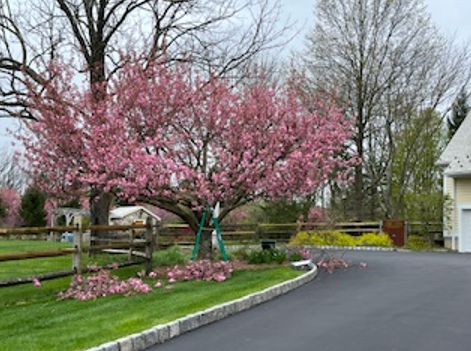
Kwanzan Cherry
Crabapples, or as I call them Crapapples too, have issues just like Cherry trees, but are more susceptible to leaf diseases than anything else such as anthracnose and powdery mildew.

Are there others?
Yes, personally, as majestic as a Sycamore and London Plane Tree can be, and their bark stands out, especially in winter along river banks and streams, they are dirty trees. They tend to drop their thin bark pieces all over in early-mid summer as well as their huge leaves due to drought or anthracnose, so sycamores need to be treated in spring. And let’s not forget the “itchy” balls or Syncarps as they fall to the ground and turn your ankles when you step on them. Speaking of syncarps, although it has gorgeous fall foliage, the Sweet Gum ‘Liquidambar styraciflua’ has even worse balls that are more of a pain as they fall by the thousands and ruin lawns.

Sycamore in winter

Sweet Gum Syncarps
More?
Then there are trees that are considered “weed” trees as they grow so fast that their wood development lacks strength. Silver Maples, Ailanthus, Mimosa, to name a few are all poor choices. So, please stick to Oaks, Maples (Sugar and Red), and Dogwoods. Let’s get real though, ALL trees have their issues, but some less than others, so choose wisely. In Fall, purchase your heavily discounted trees and plant because the moisture is typically plentiful, days are warm but not hot and nights are cool.

Silver Maple
*** Plant Health Organics is a 100% Organic land care company serving Central NJ and Bucks County PA. We are PROUD of the work we do and know full well that what we do is BEST for you and our world. Contact us at 908-335-0553.***
Voted 2026 Best Landscape Company in Hunterdon County NJ
-Joe Gentile, Owner Plant Health Organics, LLC
With offices in
Frenchtown and Monmouth County, NJ
Comments